
How to Prepare for UGC NET English in 6 Months
A practical step-by-step guide to help English aspirants prepare smarter, revise effectively, and maximize their chances of selection.
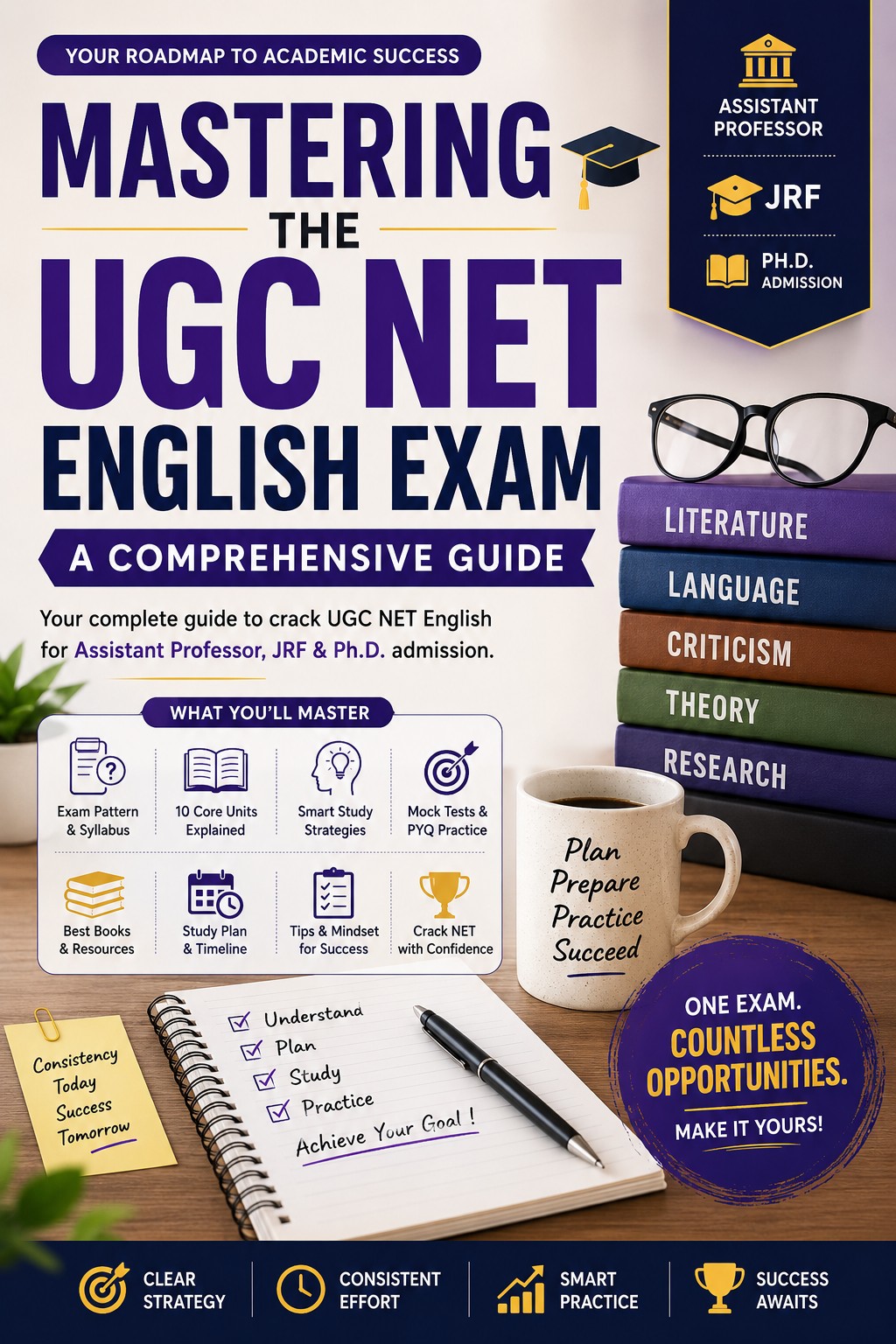
Mastering the UGC NET English Exam: A Comprehensive Guide
The UGC National Eligibility Test (NET), conducted by the National Testing Agency (NTA), is the gateway for aspirants seeking to become Assistant Professors and Junior Research Fellows (JRF) in Indian universities and colleges, and now also serves as a qualifying route for admission to Ph.D. programmes. For students of English literature and language, clearing UGC NET English is a defining milestone that certifies subject mastery and opens doors to academia and research. This guide demystifies the exam and offers a structured approach to preparation.
Understanding the UGC NET Structure
Unlike the multi-stage UPSC process, UGC NET is a single-day, single-session examination consisting of two objective-type (multiple-choice) papers, conducted back-to-back in a computer-based (online) mode. There is no descriptive writing and no interview.
Paper I – Teaching & Research Aptitude (General): 50 questions, 100 marks. Common to all candidates across subjects, it tests teaching aptitude, research aptitude, comprehension, communication, reasoning (verbal and mathematical), data interpretation, ICT, people-environment relations, and higher education systems. All questions are compulsory and there is no negative marking.
Paper II – English (Subject-specific): 100 questions, 200 marks. This paper assesses in-depth knowledge of English literature, language, and criticism. All questions are compulsory, each carries 2 marks, and there is no negative marking.
Both papers are attempted in one continuous 3-hour session (no break between them). Each correct answer earns 2 marks. The marks of both papers are combined, and JRF/Assistant Professor eligibility is decided on the aggregate and category-wise cut-offs.
Strategy: Since there is no negative marking, attempt all questions. Speed, accuracy, and wide reading matter more than selective depth.
The English Syllabus (Paper II) — Ten Core Units
The English syllabus is organised into ten units. Mastering all ten is essential, as questions are distributed across them:
- Drama – from Classical and Elizabethan to Modern and Postmodern.
- Poetry – Chaucer to the contemporary, across all major movements.
- Fiction & Short Story – the novel's evolution, forms, and major practitioners.
- Non-Fictional Prose – essays, letters, autobiography, criticism as prose.
- Language – basic concepts, theories, and pedagogy; phonetics, English in use.
- English in India – its history, evolution, and futures; Indian English writing.
- Cultural Studies – gender, race, ecology, popular culture, media.
- Literary Criticism – classical to modern critical traditions.
- Literary Theory Post World War II – structuralism, poststructuralism, postcolonialism, feminism, Marxism, etc.
- Research Methods and Materials in English – methodology, MLA style, digital humanities.
Strategy for Paper II: Build a strong chronological grasp of literary history (periods, authors, texts, dates), then layer theory and criticism on top. Memorise key quotations, first lines, coinages, and "who-said-what" facts, as NET is heavy on precise factual recall.
Crafting an Effective Study Plan
A well-structured plan is the backbone of NET preparation.
Internalise the syllabus: Keep the official NTA syllabus in front of you and map every topic you study to a unit.
Chronology first: Prepare literary history age by age (Old English → Middle English → Renaissance → Neoclassical → Romantic → Victorian → Modern → Postmodern → Indian & Postcolonial). This creates a mental scaffold for everything else.
Daily targets & consistency: Fix realistic daily and weekly goals. Consistency beats sporadic marathons.
Match-the-following & assertion-reason practice: NET's signature question types demand this practice; solve them regularly.
Mock tests: Attempt full-length, timed mocks for both papers. Analyse errors and track weak units.
Previous years' papers: Solving 5–10 years of past papers reveals recurring authors, themes, and question patterns—arguably the single most valuable exercise.
Essential Resources for UGC NET English
Literary History: A History of English Literature – Edward Albert; An Outline History of English Literature – W.H. Hudson; The Concise Cambridge History of English Literature.
Criticism & Theory: A Glossary of Literary Terms – M.H. Abrams; Beginning Theory – Peter Barry; Literary Criticism – M.A.R. Habib.
Reference & Facts: The Oxford Companion to English Literature; author biographies and famous quotations.
For Paper I: Any standard NTA UGC NET Paper I book (Trueman's / KVS Madaan) covering teaching-research aptitude, reasoning, and higher education.
Practice: NTA's previous question papers, standard NET English question banks, and reliable online test series.
Developing the Right Mindset
Clearing NET, especially with a JRF, rewards precision and stamina.
Wide, active reading: Read broadly across genres and periods rather than memorising notes passively.
Fact discipline: NET rewards exact details—dates, coinages, character names—so revise factual lists frequently.
Persistence: Many clear it after a couple of attempts; treat each attempt as diagnostic feedback.
Balance & health: Regular breaks, sleep, and revision cycles keep recall sharp for the long single-session exam.
Self-belief: Trust your reading and your revision.
Conclusion
UGC NET English is a demanding test of both breadth and precision, but with a chronological command of literary history, a firm grip on theory and criticism, disciplined factual revision, and consistent mock practice, it is very much within reach. By understanding the two-paper structure, mastering all ten units, and maintaining steady effort, you can significantly enhance your prospects of qualifying as an Assistant Professor or securing the coveted JRF. Good luck!
FAQs
What is the UGC NET English exam?
UGC NET English is a national-level examination conducted by the National Testing Agency (NTA) to determine eligibility for the post of Assistant Professor, Junior Research Fellowship (JRF), and admission to Ph.D. programmes in the subject of English.
Who can apply for UGC NET English?
Candidates who have completed or are pursuing a Master's degree in English or a related subject with the required minimum percentage prescribed by the UGC can apply. Candidates appearing in the final year of their postgraduate programme may also be eligible, subject to NTA guidelines.
What is the exam pattern of UGC NET English?
The exam consists of two papers conducted in a single three-hour session: Paper I: 50 questions (100 marks) Paper II (English): 100 questions (200 marks) Both papers are objective-type (MCQs) and are conducted online.
Is there any negative marking in UGC NET English?
No. There is no negative marking in UGC NET English. Candidates should attempt all questions to maximize their score.
How many questions are asked in Paper II (English)?
Paper II consists of 100 multiple-choice questions, carrying 2 marks each, for a total of 200 marks.
How many months are enough to prepare for UGC NET English?
A focused preparation period of 6 months is generally sufficient for most aspirants, provided they study consistently, revise regularly, solve previous year papers, and take mock tests.
Are previous year question papers important?
Yes. Previous year papers help you understand the exam pattern, identify frequently asked topics, improve time management, and familiarize yourself with the types of questions asked in UGC NET English.